
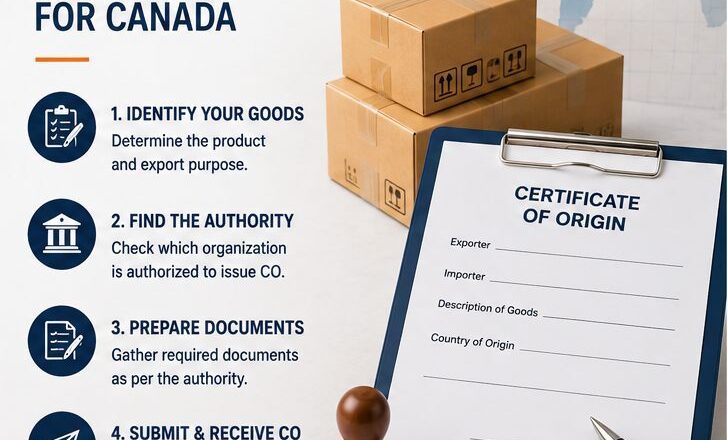
Many shop owners selling to Canada are worried after hearing that the rules for obtaining a certificate of origin (C/O) changed significantly on August 1. If you prepare your own export documents for shipments of clothing, handicrafts or dry foods to Toronto or Vancouver, filing with the wrong issuing office can leave your goods stuck at the border and even cost you the tariff preferences you would otherwise get in Canada. This article explains how to find exactly where to file your C/O for Canada under the latest rules so your goods move smoothly.
Why does it matter where you apply for a C/O for Canada from August 1?
From August 1, the authorities began reorganising and aligning which body may issue certificates of origin for each group of export goods. The change is meant to tighten control and prevent origin fraud, but it has made life harder for household businesses and e-commerce shop owners who are not used to complex paperwork.
If you file with the wrong office, you face two major risks:
- Rejected documents and missed flights: Redoing the paperwork can take weeks and delay deliveries to your customers in Canada.
- High duties from Canadian customs: When your goods arrive at a Canadian airport, if customs finds that the C/O was issued by the wrong authority or is invalid, they will refuse to apply the preferential rate under the trade agreement. Your shipment may be charged the much higher standard import duty, wiping out your price advantage.
How to find the right C/O office for Canada from August 1
To avoid confusion when preparing documents from August 1, first work out which group your goods belong to so you file at the right place.
Goods certified by the Ministry of Industry and Trade and its Import-Export Management Offices
Generally, consumer industrial goods, textiles, footwear and highly processed products exported to Canada under tariff preferences are certified by the regional Import-Export Management Offices of the Ministry of Industry and Trade (MOIT).
- How to tell: If your products are your own clothing designs, leather shoes or plastic household goods, register an account on the MOIT electronic certificate of origin system (eCoSys) first, then submit the paper file at the Import-Export Management Office where your business is registered.
- Note: A first-time application needs a very detailed explanation of the production process and invoices for the raw materials purchased.
Goods certified by the Vietnam Chamber of Commerce and Industry (VCCI)
For raw agricultural products, frozen or dried seafood, herbs, wooden handicrafts and goods that do not qualify for special tariff preferences (requiring only a standard Form B C/O), the issuing authority is VCCI and its local branches.
- How to tell: If you are sending tea, coffee, cashews or bamboo and rattan goods to a retail partner in Canada, prepare your file for the nearest VCCI office.
- Common mistake: Many shop owners assume that all agricultural products go to the MOIT, so their file sits for a week before they are told it cannot be accepted.
Document checklist for a smooth C/O application
To get your application assessed quickly without the officer asking for repeated corrections, prepare a clean set of documents including:
- Export customs declaration: Cleared and digitally signed.
- Commercial invoice: Must clearly show the product name, quantity, unit price and total value in USD or CAD.
- Packing list: A detailed description of how the goods are packed, with the net and gross weight of each package.
- Transport document: An air waybill proving the goods have been loaded.
- Proof of origin: Invoices for raw materials bought in Vietnam, import declarations for materials (if any), or an origin declaration from the Vietnamese manufacturer.
Remember that the information on all of these documents must match word for word. A single discrepancy in weight between the customs declaration and the packing list is enough to have your C/O application returned immediately.
Shipping to Canada without the customs headaches
For a small shop owner, handling the C/O, customs declarations and proof of origin yourself is a heavy burden in both time and money. Instead of struggling with the rule changes from August 1, many shops now send their goods through specialist Vietnam–Canada carriers such as Soleil Transportation.
Soleil Transportation offers flexible service options designed around what sellers need:
- Direct Vietnam–Canada air service: Door delivery from just $16/kg. This price includes all import duties and customs clearance in Canada. Just drop your goods at our Vietnam warehouse and our professional team handles the rest, so you don’t need to worry about a C/O or complex paperwork.
- ePacket: The ideal option for small parcels, gifts and e-commerce orders, from just $8.50 CAD per parcel. Average transit time is 7–12 business days, so you keep your reputation with your customers in Canada.
- Fulfillment in Canada: Storage, packing and domestic delivery in Canada from just $5 CAD per order. Send your stock in bulk to our warehouse in Mississauga, Ontario, then focus on selling while we pack and ship quickly to your customers in Canada and the US.
Every parcel shipped with Soleil Transportation is packed in a basic carton for free and comes with a clear online tracking number. You can check your order’s progress by email, SMS or Zalo at any time.
Before shipping, review your product list to make sure nothing breaks the prohibited-goods rules of either country. For detailed advice on declaring your goods and choosing the most economical service, contact Soleil Transportation on +1 888-998-5199 or email your shipment details to info@soleiltransportation.com. Our team at the warehouse at 2446 Cawthra Road, B1U8, Mississauga, Ontario is always ready to help your goods clear customs safely and quickly.