
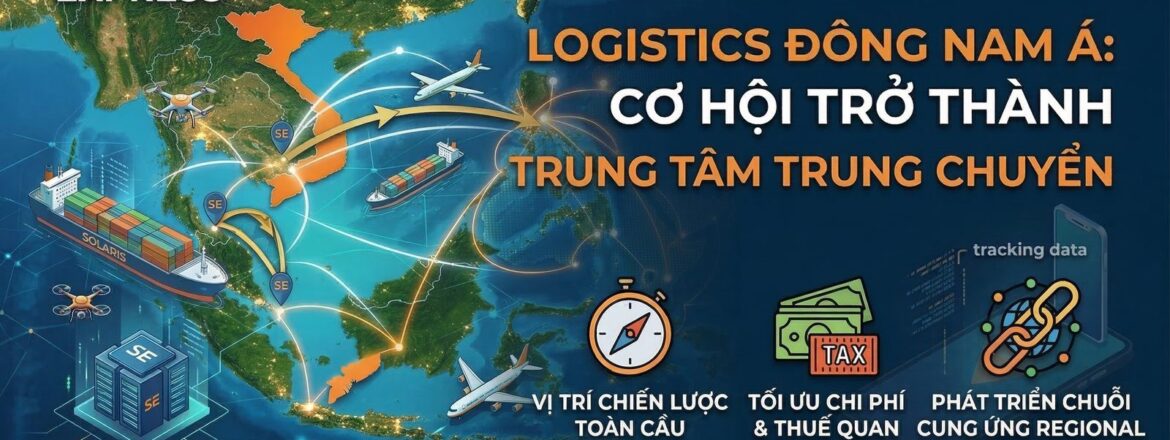
In recent years, Southeast Asian logistics has become an important link in the global supply chain. Trade growth within ASEAN, the e-commerce boom and free trade agreements have all driven up demand for freight and transshipment.
Thanks to their strategic location and heavy investment in ports and airports, many countries in the region are aiming to become a Southeast Asian logistics hub. This opens up a big opportunity for the region to become Asia’s transshipment centre.
Southeast Asian logistics and the rise of transshipment hubs
The rapid growth of Southeast Asian logistics is paving the way for large-scale transshipment hubs. According to many market reports, the region’s logistics industry is growing by double digits every year on the back of rising freight demand.
Logistics infrastructure investment in the region
Countries such as Vietnam, Singapore and Thailand are investing heavily in seaports, international airports and transport infrastructure. These projects improve trade connections and help regional supply chains run more efficiently.
What is driving the Southeast Asian logistics hub
Key drivers of logistics growth in the region include:
- Trade growth within ASEAN.
- The e-commerce boom.
- Investment in seaports and international airports.
- Digital technology in logistics management.
Together, these factors are making Southeast Asia an important transshipment point for the region.
The opportunity to build a logistics hub in Southeast Asia
Southeast Asia has many advantages as a global transshipment centre. The region sits on major shipping lanes connecting Asia with Europe and the Americas.
Location and infrastructure advantages
Many countries in the region are developing deep-water ports, distribution centres and modern warehouses to increase their logistics capacity. These investments lower shipping costs and speed up delivery.
Trade growth and regional supply chains
Strong growth in e-commerce and regional manufacturing is also driving demand for logistics services. Logistics companies are expanding their warehouse and transport networks to keep up with demand.
According to a report from logistics.gov.vn, the ASEAN logistics industry is expected to keep growing strongly in the coming years.
Challenges and development strategies
Despite its potential, Southeast Asian logistics still faces challenges such as high logistics costs, uneven infrastructure and the risk of disruption to regional supply chains.
Strategies for sustainable logistics growth
To grow sustainably, countries need to focus on a few key areas:
- Upgrade logistics infrastructure: Integrate multimodal transport systems.
- Develop green logistics: Cut carbon emissions in transport.
- Digitise the supply chain: Use AI and blockchain to manage shipping documents.
- Strengthen regional trade cooperation: Use agreements such as RCEP to optimise tariffs.
These strategies will help the Southeast Asian logistics hub become more competitive in the future.
Southeast Asian logistics has a big opportunity to become a key transshipment centre for global trade. With its favourable location, growing trade and investment in logistics infrastructure, the region has the potential to become a Southeast Asian logistics hub.
To seize this opportunity, however, countries need to keep improving infrastructure, adopting technology and deepening cooperation across regional supply chains.
Final thoughts
A reliable shipping service saves you time and money and protects you from risk when you ship internationally. Soleil Transportation is proud to offer safe, fast and professional Vietnam to Canada shipping.
Contact us today for advice and our latest rates!